EXECUTIVE COMMUNICATIONS • SPEECHWRITING • STORYTELLING PROCESS
The Strange Work of Making Someone Sound Like Themselves
How high-stakes speeches are built from pressure, subtraction, rehearsal, and voice.

Three months into the job, Hubert Southall opened his calendar and saw the problem before he had language for it. There was another leadership talk coming. Then another. Then another. The organization had moved from occasional all-hands meetings and quarterly AMAs to a weekly cadence of senior-leader presentations. Vice presidents, distinguished engineers, and directors were expected to show up more often, speak more directly, and help remote teams feel closer to the people making decisions.
The intention was sound. The operating reality was not.
He was the only internal communications person in the organization. The role itself was still being defined. He was already handling the loose weather system of executive work: six-page proposals, PRFAQs, white papers, compliance reports, town hall scripts, leadership narratives, and the sudden writing emergencies that appear around senior people with little time and large audiences. Now every week required a polished, useful, visually engaging, one-hour leadership session. The talks would be recorded and archived. A confused talk would not end when the meeting ended. It would remain available, as evidence.
The first speaker sent over what looked like a responsible amount of material, which is to say far too much of it. There was an old deck, a strategy document, a page of metrics, a few pet points from stakeholders, a paragraph that sounded important because it had survived several revisions, and a list of things “we should probably mention.”

This was the moment the central failure mode of executive communication became visible.
Completeness is a seductive failure.
It feels like rigor. It looks like preparation. It reassures every stakeholder that their concern has been represented. But completeness is often the enemy of being understood. A speech can be full and still have no center. It can be accurate and still leave the audience with nothing they can carry away.
This was not a problem of intelligence. The leaders he worked with were rarely underprepared. They were usually overprepared. They knew the architecture of a program, the history of a decision, the risks, the metrics, the politics, and the objections. They had more than enough material. The problem was that the audience could not be expected to hold all of it.
So he did not begin by writing. He began by diagnosing.
His first question was not “What do you want to say?” It was “What has to be different in the room when you are done?”
That question changed the assignment. The talk was no longer a container for information. It became an instrument for changing an audience’s state. Did the audience need to understand a strategy? Accept a decision? Feel closer to leadership? Move faster? Worry less? Worry more? Trust that someone competent was paying attention?
The early meetings became less like brainstorms than examinations. He listened for pressure: business pressure, audience pressure, speaker pressure, time pressure. He listened for what could not be said badly. A leader might arrive wanting to explain a technical program, but the actual task might be to restore trust. Another might want to inspire, when the room needed clarity more than altitude. Another might want to share a strategy, when the audience first needed permission to stop doing something old.
The intake questions were plain. What is this session for? What does the audience already believe? What are they likely to resist? What are they tired of hearing? What do they need from you specifically? What can only you say? What should they understand, feel, or do differently afterward?
The questions made the work slower at the start and faster everywhere else.
Out of those questions came what he called the load-bearing idea. A topic might be artificial intelligence governance, organizational change, security culture, talent development, or quarterly performance. A message was harder. It was the one idea that had to survive if the slides failed, if the session ran short, if the audience remembered only a sentence on the way back to work.
Finding it required subtraction.
He removed the inherited paragraph, the ornamental metric, the duplicated point, the clever line that sounded like the writer instead of the speaker. This last category mattered more than people expected. A sentence could be elegant and still be wrong. It could read beautifully and die in the speaker’s mouth. Speechwriting punished vanity with unusual efficiency. The audience was not there to admire the writer. The audience was there to believe the speaker.

The strange part of the work was that he was trying to make someone sound more like themselves, not more polished.
He studied a speaker less like a mimic than like a mechanic listening to an engine. Did the person think in examples, principles, warnings, contrasts, or lists? Did they prefer to state the answer first or build to it? What kind of evidence made them more confident? When did they become animated? When did they retreat into abstraction? What phrase did they use naturally that no communications draft would have invented?
Just as important, what would they never say?
One technical leader revealed the pattern quickly. He came into an intake session with a precise explanation of a system. The explanation was accurate, orderly, and almost impossible to follow. The temptation was to simplify the language. But the language was not the main problem. The sequence was. The leader was explaining the architecture before the audience understood the pain. He had put the mechanism before the meaning.
The fix was to move the human consequence forward. First the problem. Then the stakes. Then the system. The vocabulary changed less than expected. The order changed everything.
This became a rule. Do not simplify a speaker by sanding off their intelligence. Simplify the path the audience has to walk.
Different speakers required different protection from themselves. The deeply technical speaker, whose strength was precision, could become dry and overlong. The charismatic speaker, whose strength was energy, could become scattered. The warm speaker, whose strength was care, could become apologetic. The powerful speaker, whose strength was authority, could become sharp enough to make the room defensive.
The goal was not to replace their style. It was to keep their style from collapsing under pressure.
The problem was that this kind of attention did not scale naturally. By the third or fourth request, the trap was clear: if every talk required a custom process, the process itself would consume the week. The question became how to preserve custom craft when demand kept rising.
He divided the work into two categories: what had to be custom and what had no business being custom.
The argument was custom. The leader’s voice was custom. The audience’s resistance was custom. The coaching was custom.
Scheduling was not. Intake logistics were not. Review expectations were not. The sequence of draft, deck, feedback, dry run, and delivery was not. Those had to become predictable.
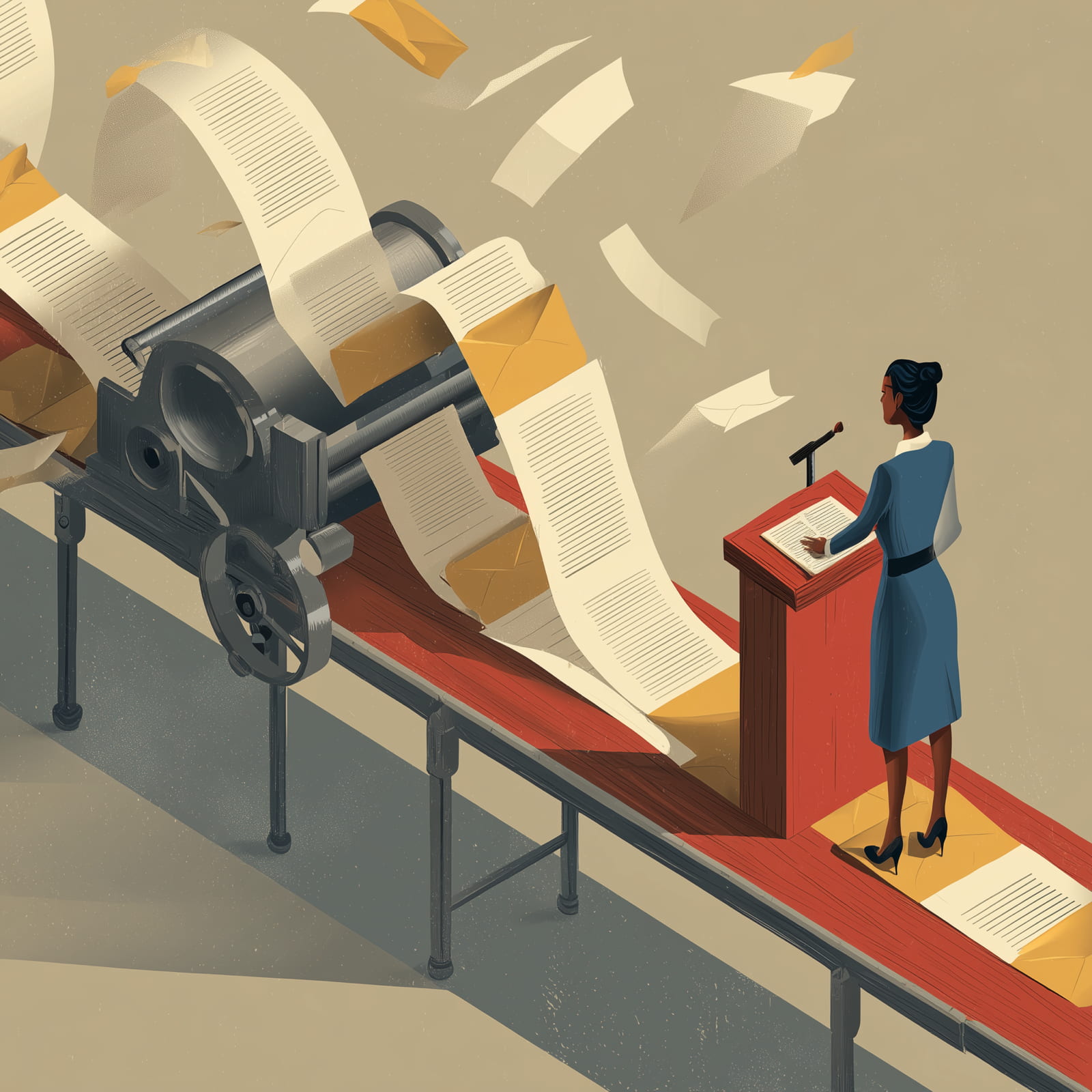
He built a three-week mechanism. Week one was intake: purpose, audience, resistance, story, action. Week two was production and review: script, deck, leader feedback, executive-assistant coordination. Week three was rehearsal: delivery coaching, final edits, and the moment when the written talk met the actual person who had to say it.
At any given time, he could keep three talks in motion: one in intake, one in production, one in rehearsal. The mechanism made weekly delivery possible without pretending every talk was the same. It also gave leaders something they rarely got from communications work: predictability. They knew what was coming. They knew what was expected. They were not being handled. They were being supported by a system that respected their time.
Still, the system did not always work.
One leader did not want to rehearse. He was experienced, busy, and confident in the way experienced, busy people often are. He knew the material. He had spoken publicly before. The draft was strong enough on the page, and the calendar was tight. Rehearsal seemed like an optional ceremony.
The speechwriter pushed, but not hard enough at first. The leader skimmed, made a few edits, and arrived close to delivery assuming the words would become his once he began saying them.
They did not.
The opening was too written. The transitions were logical but not felt. The leader rushed the difficult section and slowed down on the background, precisely the opposite of what the audience needed. A sentence designed to land as a decision rose at the end like a question. Nothing catastrophic happened. That was almost the problem. It was the kind of talk that could pass without working.
Afterward, the mechanism changed. Rehearsal could no longer be treated as a courtesy. It had to be built into the system as a decision point. A talk was not finished because the document had been approved. It was finished when the speaker could carry it.

This was perhaps the most important discovery of the year. Rehearsal was not polish. It was the last writing stage.
The body revealed what the document concealed. A sentence might ask for too much breath. A transition might look logical and feel abrupt. A paragraph might be accurate but lifeless. He listened for speed, strain, hesitation, buried emphasis, false confidence, and over-explanation.
The edits were small because the audience felt the small things first.
Pause here. Cut this clause. Look up before the number. Do not apologize for the ask. Say “we decided,” not “the decision was made.” Move the example earlier. Let the silence sit. This is the line. Do not rush it.
He did not tell speakers simply to calm down. Calm is often too far away. The body under public scrutiny has already made its decision: heart rate up, breathing shallow, attention narrowed. The better move was to give the energy a path. Know the first sixty seconds. Know the first transition. Know where to breathe. Know the sentence that must not be buried.
Preparation did not eliminate nerves. It made them usable.
By the end of the year, the mechanism had produced more than forty one-hour leadership presentations, roughly one each week. But the clearer measure came in rehearsal, in smaller evidence.
A leader would arrive with a paragraph that sounded like it had been built by committee. The speechwriter would ask what he meant by it. The leader would explain, plainly, in his own words. He would stop him.
“Say that.”