Executive Communications · Speechwriting · Media Preparation
The Hidden Work Behind Every Great Talk
Technical leaders rarely fail on stage because they lack command of the material. They fail because no one translated the material for the audience in the room. Customers need trust, engineers need precision, executives need implications, journalists need plain language without losing accuracy. Each audience requires a different translation of the same expertise, and the discipline of doing that translation well is what turns command of the material into a talk an audience can follow, remember, and trust. Hubert has built and practiced that discipline across more than a decade of executive communications work, across companies, formats, and audiences. AWS Security is where it scaled.
The translation problem
Production support was the wrong unit of work
Most large organizations treat presentation help as event production. Slides, rehearsals, AV, run of show. That fits a single keynote. It does not fit an organization with more than fifty speakers, from Directors to SVPs including Distinguished Engineers, being asked into keynotes at re:Invent, re:Inforce, RSA, Gartner, TEDx, and BSides, plus podcasts, media interviews, press conferences, firesides, and the occasional long-form piece a leader needed to publish under their name. AWS Security was where the discipline ran at the largest scale, and where the production model broke most visibly. COVID and virtual delivery sharpened the problem but did not create it. Production-grade support begins at the deck, and by then the talk has been built around what the speaker knows rather than what the audience needs. Rehearsal cannot recover what intake should have done.
Intake was the unit of work, not the deck
Hubert inverted the order. Intake before slides. Audience strategy before narrative. Narrative before design. Coaching shaped to the individual. The same logic carried into podcasts, media, press, firesides, and the written pieces that needed the same translation work as a keynote. The counter-position was to leave the work to comms generalists and event teams, the default in most organizations and the reason their technical leaders sound fluent in a room and uncertain on a stage. Generalist support optimizes the artifact. Translation work optimizes the encounter.
The readiness system
The mechanism was preparation, not polish
Every engagement opened with intake. What was the moment, who was the audience, what did they already know, what did they need to believe or do afterward, why was this speaker the right one. The questions are simple. They are almost never asked before a deck gets built, which is why decks built without them rarely survive contact with an audience.
Topic analysis came next. Was the angle fresh, the depth right, the security sensitivity manageable, the speaker credible on this particular point. Weak topics were cut before they consumed rehearsal time, which is the expense most speaker programs absorb silently.
Audience translation is the move technical organizations get wrong most often. The same expertise has to be delivered four different ways for four different audiences, and no amount of additional slides closes the gap.
Narrative came before design. Central idea, the tension behind it, the sequence, the takeaway. Decks supported the speaker rather than replacing them, which meant cutting the density technical speakers add reflexively as proof they know the material.
Coaching was personalized through an archetype framework that matched preparation style to speaker behavior. Students wanted checklists. Type A Perfectionists used preparation as armor and needed contingency drills. Creative Iterators needed a freeze point. Knowledge-Rich Experts needed help cutting data and trusting that clarity is not the enemy of rigor. The framework was what let personalized coaching scale past fifty leaders without flattening into a template.
Making Security Training Less Boring
This talk was delivered at RSA Conference 2023, where it ranked in the top 10 out of 400 sessions. It takes one of the driest internal topics, cybersecurity awareness training, and reframes it as a problem of emotion, attention, and behavior change. The slides show the visual argument. The speaker track shows how the idea was carried from metaphor to method.
Making Ransomware Readiness Actionable
A customer-facing AWS Security eBook that turns ransomware risk into a practical readiness framework.
This ransomware guide translates a broad, fear-heavy security topic into concrete guidance customers can act on. It explains what ransomware is, why organizations are concerned, and how AWS customers can strengthen protection through security frameworks, patching, credential hygiene, backup strategy, incident response planning, self-assessments, and automation.
Amazon S3 Security and Data Protection
A customer-facing AWS guide that organizes S3 security and data protection practices into a clear, usable framework.
This S3 guide translates a deep technical service area into a structured customer resource. It explains shared responsibility, access management, default security settings, encryption, least privilege, monitoring, auditing, versioning, Object Lock, replication, and backup strategy in a way customers can evaluate against their own environments.
Teaching the Mechanism
This lightning talk uses the Prussian potato story to explain why formats matter. The point is not the potato. The point is the mechanism: make the behavior desirable, constrain the format, and give ideas a stage people actually want to watch.
Turning Engagement Data Into Design Rules
This audit deck translated noisy landing-page engagement data into practical design guidance for creative and production teams. It converted raw component metrics into clearer rules around tabs, videos, galleries, scroll depth, mobile-aware design, and cleaner future measurement.
On Display
Click any example to see the full presentation.
Making Security Training Less Boring
A dry treatise on cybersecurity awareness is reframed as a study in human behavior. Delivered at RSA 2023, this top-ten presentation steers a notoriously dull corporate ritual away from compliance spreadsheets and toward genuine emotional engagement.
Securing the Internet with Cloud Innovation
Why the cloud is now the internet's security layer.
Security Expectations & Service Teams
Why security holds only when it's measured, not preached.
Teaching the Mechanism
Using an old anecdote about Prussian potatoes, this lightning talk explores how format dictates human action. The focus is structural, offering a witty blueprint for constraining options while keeping an audience entirely captivated.
Turning Engagement Data Into Design Rules
An audit deck that coaxes quiet order out of chaotic landing-page metrics. Raw data points are distilled into sharp, component-level directives, establishing clear design boundaries for creative and production teams alike.
AWS Security Leader Talks
These are public YouTube recordings of AWS Security talks and presentations I produced and speaker-coached. Each link opens a recorded example of the same work described above: shaping the message, preparing the speaker, and translating technical expertise for a live or public audience.
AWS re:Inforce 2022 - Keynote
This AWS re:Inforce keynote brought together senior AWS and customer security leaders to discuss cloud security innovation, security leadership, and how organizations can foster a stronger culture of security inside their businesses.
Watch on YouTubeDefining the Role of Distinguished Engineers at AWS
This video is an executive conversation about AWS security culture, the role of Distinguished Engineers at AWS, and the career of a senior AWS security leader and Distinguished Engineer.
Watch on YouTubeAWS re:Inforce 2021: Scaling security, one human at a time
This AWS re:Inforce leadership session explains the techniques and mechanisms AWS uses to scale its security program, along with ways customers can strengthen their own security strategies.
Watch on YouTubeResults
- CSAT never dropped below 4.39 out of 5 across the service
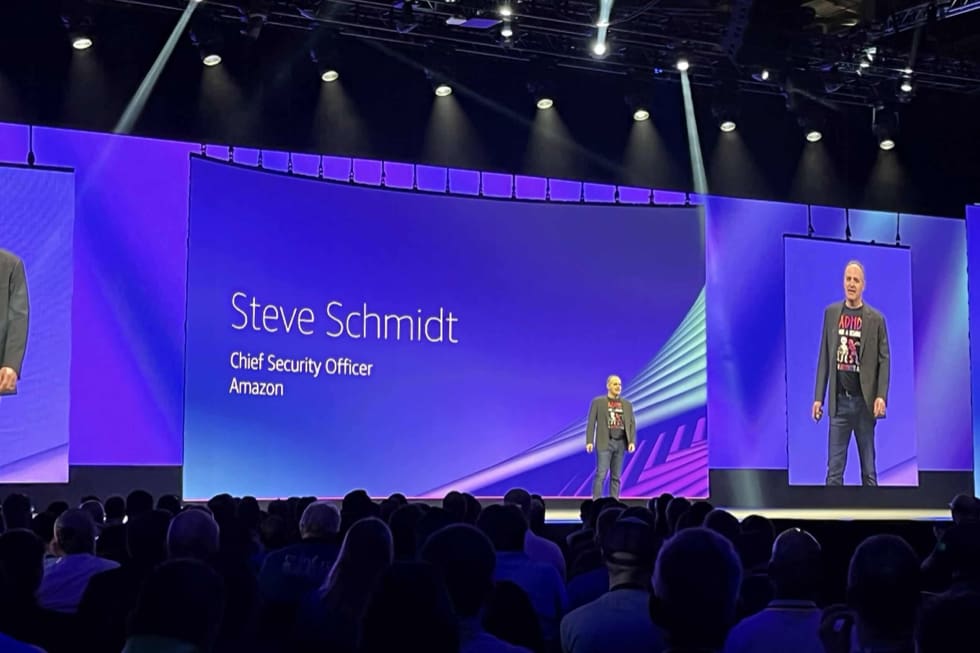
- Steve Schmidt's re:Invent keynote earned 4.6 out of 5 and ranked #2 among all event keynotes
- re:Inforce session with three Directors earned 4.57 out of 5 for Speaker Knowledge and Effectiveness
- 100+ C-suite keynotes for SVPs, CTOs, and Amazon Board meetings, 4.73 average CSAT
- 100+ keynotes produced or supported across re:Invent, re:Inforce, TEDx, RSA, Gartner, BSides
- 30+ leaders supported in a 12-month period, 50+ Amazonians overall, Directors to SVPs
- Built a self-directed learning program so others inside the organization could do the work, scaling the discipline beyond a single owner
Why it matters
Every organization with senior technical leaders in public-facing roles has the same gap, and most do not have anyone who owns it. The work that changes outcomes, intake, translation, narrative, individualized coaching, sits unclaimed between producers, designers, and event teams. The discipline is portable. It has carried across companies, formats, and audiences, and AWS Security is the case where it operated at the largest scale. Any company putting technical leaders on stages, in front of cameras, across from journalists, or onto the page needs it. The harder move is making it teachable, so the practice outlasts the practitioner who built it. Hubert did both.