REPORT: COMMUNICATIONS · STRATEGY
How Base.vn Broke the Western Monopoly on Vietnamese Enterprise Trust
When the local choice becomes the better choice, everything changes.

Across emerging Asia, foreign platforms dominate on reputation, not fit. That reputation is becoming more fragile. Base.vn, the Vietnamese answer to Salesforce, acquired 10,000 enterprise customers in its first year not by out-engineering the incumbent but by recognizing that local operators were ready to abandon the "West is Best" reflex, and that no domestic challenger had yet given them permission. The campaign gave them permission, then gave them a category to walk into.
The market was shifting before anyone named it
The Vietnamese enterprise market in 2017 looked stable. American platforms held prestige and establishment. Local alternatives were a gamble a serious CEO did not take. The reputational cost of betting on an unproven Vietnamese vendor and being wrong was career-ending in a way that betting on Salesforce never was. Operators absorbed English-only or poorly translated interfaces and offshore support lines as the unavoidable tax of using the best tools. The friction never translated into churn. It translated into resignation.
The market looked settled. It wasn't. Government rhetoric and aspirations around digital self-reliance had moved from media quotes to policy direction. Domestic technical capacity had matured past copycat into credible. No single event tipped the system. The incumbents read the surface and assumed loyalty. The signal underneath was that the market was loyal to an idea, and the idea was contestable.

The bet: reframe local as the responsible choice
The smart opposing view was straightforward. Prestige is durable. Switching costs are high. Local challengers compete on price, not category. The right play for a Vietnamese SaaS entrant was to position as the affordable alternative and accept second-tier perception as the cost of entry.
The communications strategy was to make a call to reject standard operating procedure. The positioning was "Made in Vietnam." The strategic concept was "Digital Sovereignty," the argument that operational control, local data confidence, and cultural fluency were not consolation prizes but the actual definition of a responsible enterprise choice. The inversion: Western platform meant global prestige plus local friction. Base.vn meant local fluency plus operational autonomy. The campaign did not ask operators to lower their standards. It asked them to notice that their standards no longer matched their market.
The mechanism: humor as permission
Hubert commissioned an internal study of the top 50 Vietnamese marketing campaigns of the previous five years. Roughly 70% nested into the humor category. The reason mattered more than the number. Operators would not publicly admit that English-only platforms made them feel excluded. The ego cost was too high. But they would laugh at an oversized English-only instruction manual planted in a business district, and the laughter did the admission for them.
Execution leaned into that opening:
- Oversized "English-only" manuals staged in central business districts
- Social challenges and radio skits dramatizing offshore support calls
- Coordinated earned media leveraging institutional investors (FPT, VIISA) to secure a Ministry of Information and Communications endorsement
Humor isolated poor localization from the competitive noise of feature comparison. The Ministry endorsement closed the safety question that prestige had previously owned.
Operational design
Cross-functional alignment for product, support, and communications was centralized through the CEO, eliminating the matrixed drag that normally slows multi-discipline launches. Preemptive government backing collapsed policy review timelines to zero. A modular API architecture underwrote the switch technically, giving enterprises a credible integration path without rip-and-replace risk.
Results
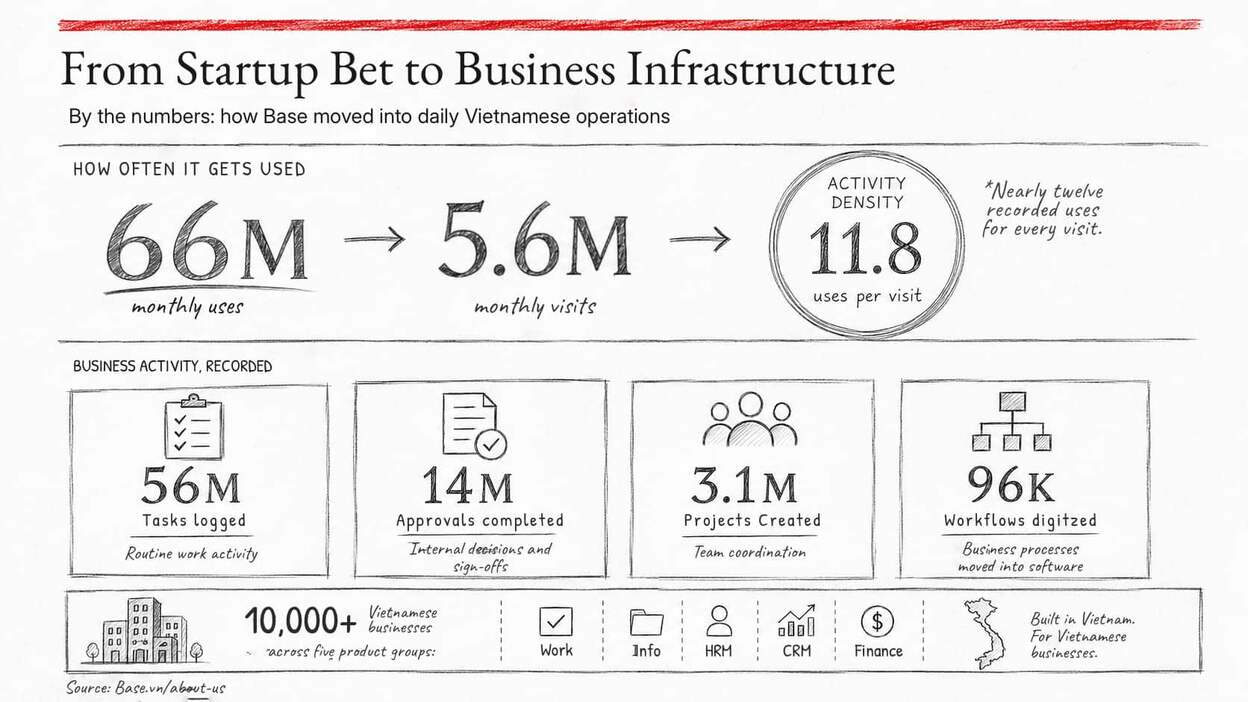
- 10,000 enterprise customers acquired in year one
- 11,000+ Vietnamese businesses on the platform by public reporting
- Top-5 ranking in the Vietnamese SaaS ecosystem by 2021
- Communications mandate expanded post-launch to absorb Creative Operations
- Majority stake acquired by FPT in 2021
Why it matters
The incumbents in Vietnam did not lose because their product was worse. They lost because they mistook their reputation for a durable advantage. Reputation is a story buyers tell themselves about what is safe, and stories are the territory of communications, not engineering. In any emerging market where foreign technology wins on brand rather than fit, that win is less stable than the incumbents believe, and the challenger that wins is the one that treats communications as the lead function rather than the support function. Localization is not a feature. It is the trust infrastructure on which buyers decide, and it is built in language and narrative before it is ever built in code.