CREATIVE · EVENTS · COMMUNICATIONS
AXE Apollo: The Launch That Became a Mission
How a global deodorant campaign became a space-recruitment platform, then came to life through cinemas, malls, street takeovers, desert shoots, and local ideas that travelled across markets.
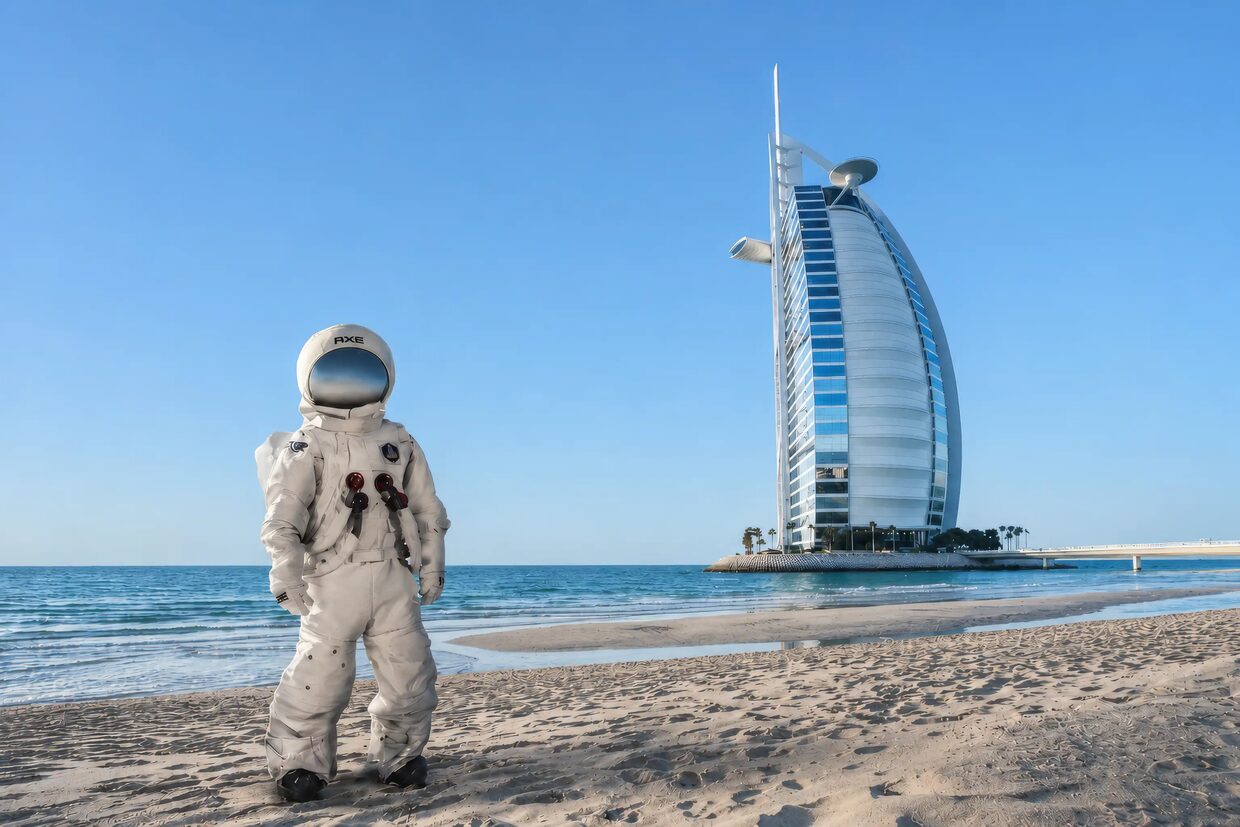
In 2013, AXE needed to make a familiar brand promise feel new again. For years, the brand had owned a simple male fantasy: spray the product, become more attractive. It was exaggerated, juvenile, funny, and instantly recognizable. But Apollo needed more than another seduction joke. It needed a bigger stage.
The answer was space. AXE Apollo turned the brand’s usual attraction promise into a hero fantasy: send men into space to impress girls. The logic was simple. Girls go for guys with great stories, and the greatest story a guy could ever have was flying into outer space. Because nothing beats an astronaut. Not an Instagram model. Not a tech billionaire. Nothing.
That was the genius of the idea. AXE was not simply advertising a fragrance. It was creating a recruitment platform. The product launch became a mission. The audience was not asked to just watch the campaign. They were asked to enlist in it.
Globally, Apollo had all the machinery of a major integrated launch: celebrity endorsement, TV, digital participation, social voting, PR, experiential stunts, and the promise of a once-in-a-lifetime prize. The campaign invited people around the world to join the AXE Apollo Space Academy, create astronaut profiles, campaign for votes, and compete for the chance to train like astronauts. AXE positioned Apollo as the biggest product launch in the brand’s 30-year history, with recruitment across 60 countries and 45 languages.
But the most interesting part of Apollo was not only its global scale. It was how the platform gave local markets room to build. In the Gulf, the campaign found a sharper local tension: a brutally competitive dating market where men heavily outnumbered women. That made the astronaut idea feel less like a random gag and more like a social weapon. The campaign did not just sell fragrance as attraction. It sold the one thing every guy needed: a better story.
The Gulf rollout turned that idea into a living recruitment drive. Before the astronauts arrived, consumers were invited to welcome them through geotagged Instagram posts. Two weeks later, AXE astronauts went to those exact locations, visited more than 30 of the welcome spots, took photos, and thanked the people who had invited them. The campaign did not just ask people to participate online. It rewarded them by sending the fantasy back into the real world.
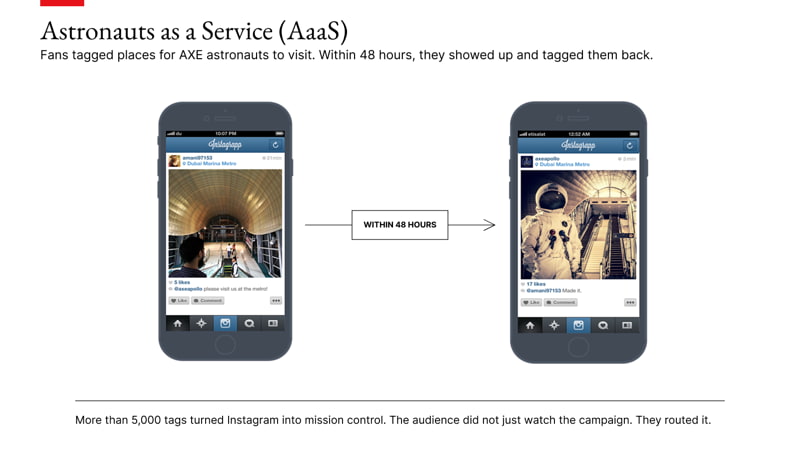
That was the core of the Gulf work. Digital participation was not trapped on a screen. It spilled into the city. The campaign became more than a recruitment mechanic or a TV idea. It became a physical world, with Dubai helping lead the way.

Cinemas became Space Academy training centers. Instead of treating the cinema as passive media space, the campaign turned the room into a launch environment. When the lights went out, audiences found themselves playing the role of brave new cadets, receiving a briefing from their Sergeant Admiral before the film began. A normal cinema ad asks people to sit down and watch. This activation recruited them into the fiction. The pre-show became a mission briefing. The audience became part of the Academy.
That shift is important. It is the difference between exposure and participation. In most advertising, people watch the brand world from the outside. In the cinema execution, they were placed inside it. For a few minutes, the room behaved as if the audience had already joined the mission.
The campaign then pushed into the city through guerrilla, social, and direct work. Public restrooms became part of the story through lipstick love notes written on men’s bathroom mirrors. The lines were not subtle, and they were not trying to be. They played with rockets, blast off jokes, and the 100,000-mile-high club. It was blunt, cheeky, and completely AXE.
But the mechanic made it smarter than a one-off gag. The notes drove guys to call a phone number. Thousands did. What they got was a voicemail, while hidden cameras captured their reactions. The footage was then leaked online and spread socially. So the activation did not just interrupt a bathroom mirror. It created a reaction loop: private surprise, recorded behavior, online release, and wider social reach.
The campaign also moved directly into the dating context, showing up on Tinder and online dating sites. That mattered because it placed AXE Apollo inside the behavior it was trying to influence. It was not just talking about attraction from a billboard. It was showing up where guys were actively trying to stand out.
The city takeover pushed the idea even further. Astronauts appearing across downtown made the campaign feel as if it had escaped the ad break and landed in real life. That mattered because Apollo depended on scale. If AXE was going to sell the fantasy of ordinary guys becoming space heroes, the world around them needed to behave as if the mission had arrived.
The installations added a bigger physical layer. In metro stations, a giant 6 x 2 meter interactive asteroid appeared as a strange object from the Apollo world. Behind its peepholes lived different pieces of video content, turning a commute into an encounter with the campaign. The train station was a smart setting because it is the starting point for everyday journeys. AXE turned it into the starting point for what could be the greatest journey.
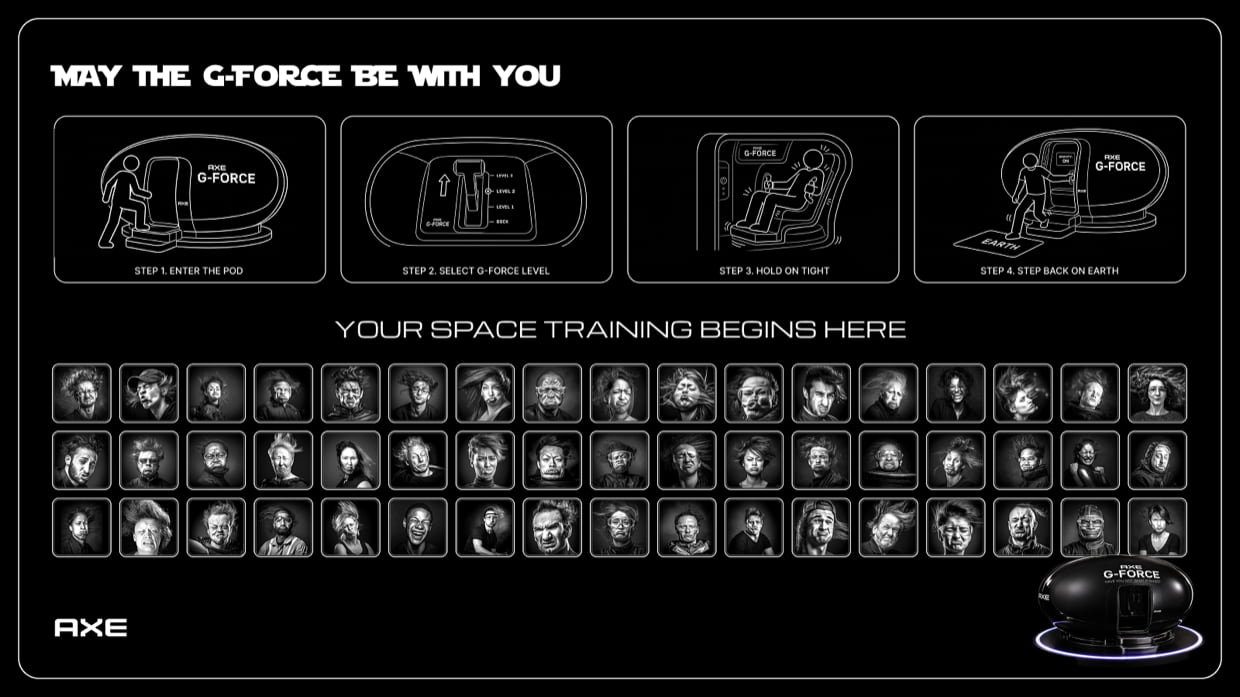
The interactive experience pushed the training idea harder. A space escape pod gave consumers the chance to see whether they could withstand a simulation of the G-force pressure felt when leaving Earth’s atmosphere. The line was pure AXE: astronauts need good stamina. Can you last two minutes? The joke was obvious, but the role-play was effective. It turned the campaign promise into something physical, competitive, and public.
The desert shoot gave the campaign cinematic scale. Sand, heat, horizon, and emptiness already have a strange relationship with science fiction. Put an astronaut into that landscape and the desert starts to feel lunar. The setting made the space fantasy feel locally grounded without making it smaller.
All of this was supported by print, outdoor, point of sale, digital, and events, with communications driving people back to the AXE Apollo website, where astronaut hopefuls could apply to head into outer space. That made the campaign feel connected rather than scattered. Every piece pointed back to the same world: recruitment, training, stamina, attraction, space.
This is what strong localization does. It does not just swap language or resize assets. It finds the part of the global idea the local market can make bigger. The Gulf work gave Apollo new forms: geotagged invitations, mission briefings, dating-site interventions, lipstick provocations, astronaut takeovers, asteroid installations, G-force simulations, and desert spectacle. Many of the ideas that started there were later picked up or echoed by the US, UK, and other regions, which says something important: the region was not just adapting the global campaign. It was helping lead it.
AXE Apollo worked because every touchpoint behaved like part of the same mission. A cinema was not a cinema. A metro station was not a metro station. A bathroom mirror was not a bathroom mirror. A downtown street was not just a street. Each became part of the Apollo universe.
The campaign was loud, ridiculous, and completely AXE. But underneath the teenage fantasy was a disciplined system. The astronaut was not decoration. It was the role, the reward, the joke, the visual code, and the participation mechanic.
Campaign-reported results said Apollo became the most successful campaign in AXE history, generating a 14 percent sales increase on the previous year’s campaign and 79 percent more than the year before that. The numbers matter, but the bigger lesson is creative. AXE Apollo started as a product launch. The Gulf helped prove it could become a mission.
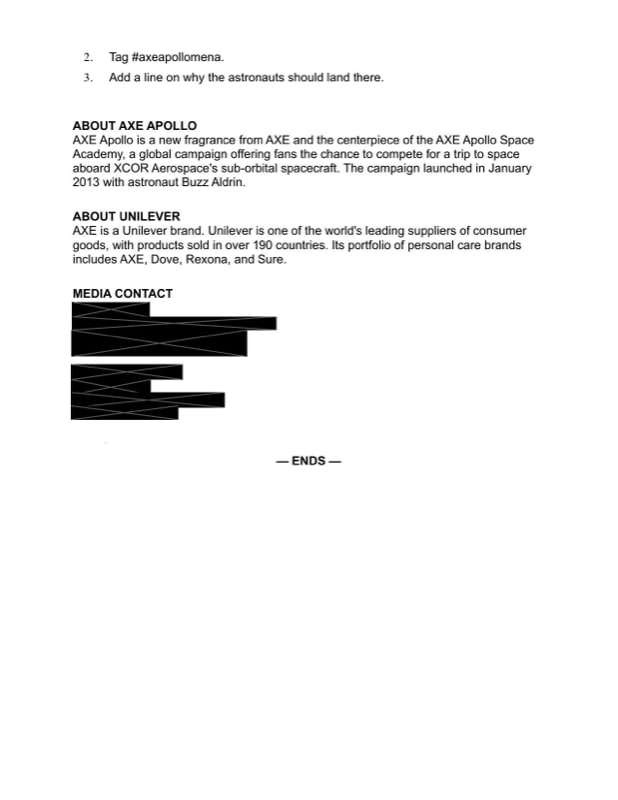
Press release