MEDIA RELATIONS · COMMUNICATIONS · PROGRAM MANAGEMENT
A Signal Through the Fog
Report: How AWS Security made itself quotable before it needed to be

Executive Summary
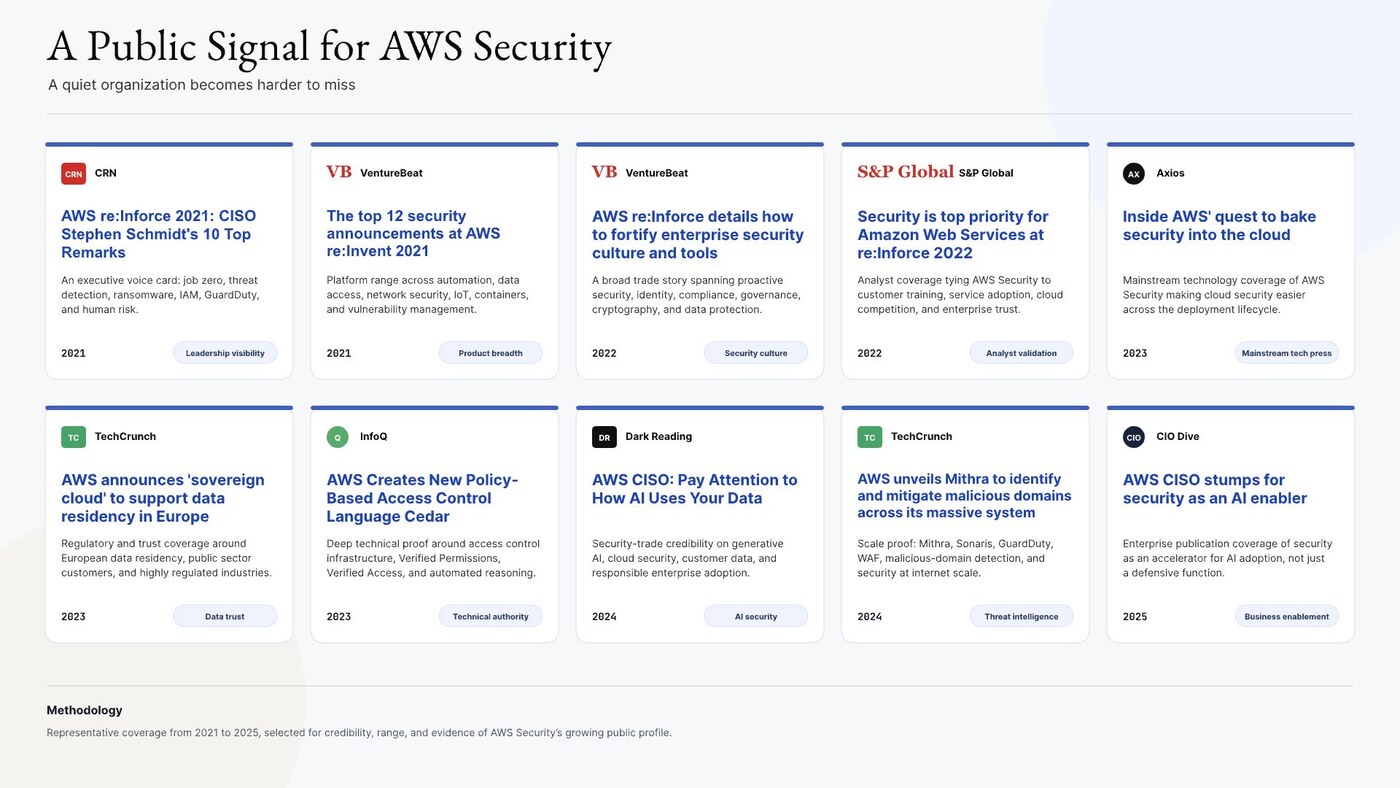
AWS launched in 2006 and helped create an industry now worth roughly $800 billion worldwide. The cloud pioneer had prioritized cybersecurity from the start, yet it had never marketed security with the same visibility as its technical leadership. For nearly two decades, that worked. Then the market changed. High-profile cyberattacks became more prevalent and moved into mainstream news. Customers and boards became more aware of enterprise security risk. Google and Microsoft treated security as an open market position, investing heavily in visibility, relationships, and influence across the cybersecurity landscape. AWS had a perception problem despite being the market leader: it needed to raise its security profile and build stronger relationships with the media. Hubert was given that challenge and built the Lighthouse model to meet it. By the end of his work, top-tier presence for AWS rose 250% year over year, share of voice climbed roughly 40% annually, and inbound media engagement grew thirtyfold.
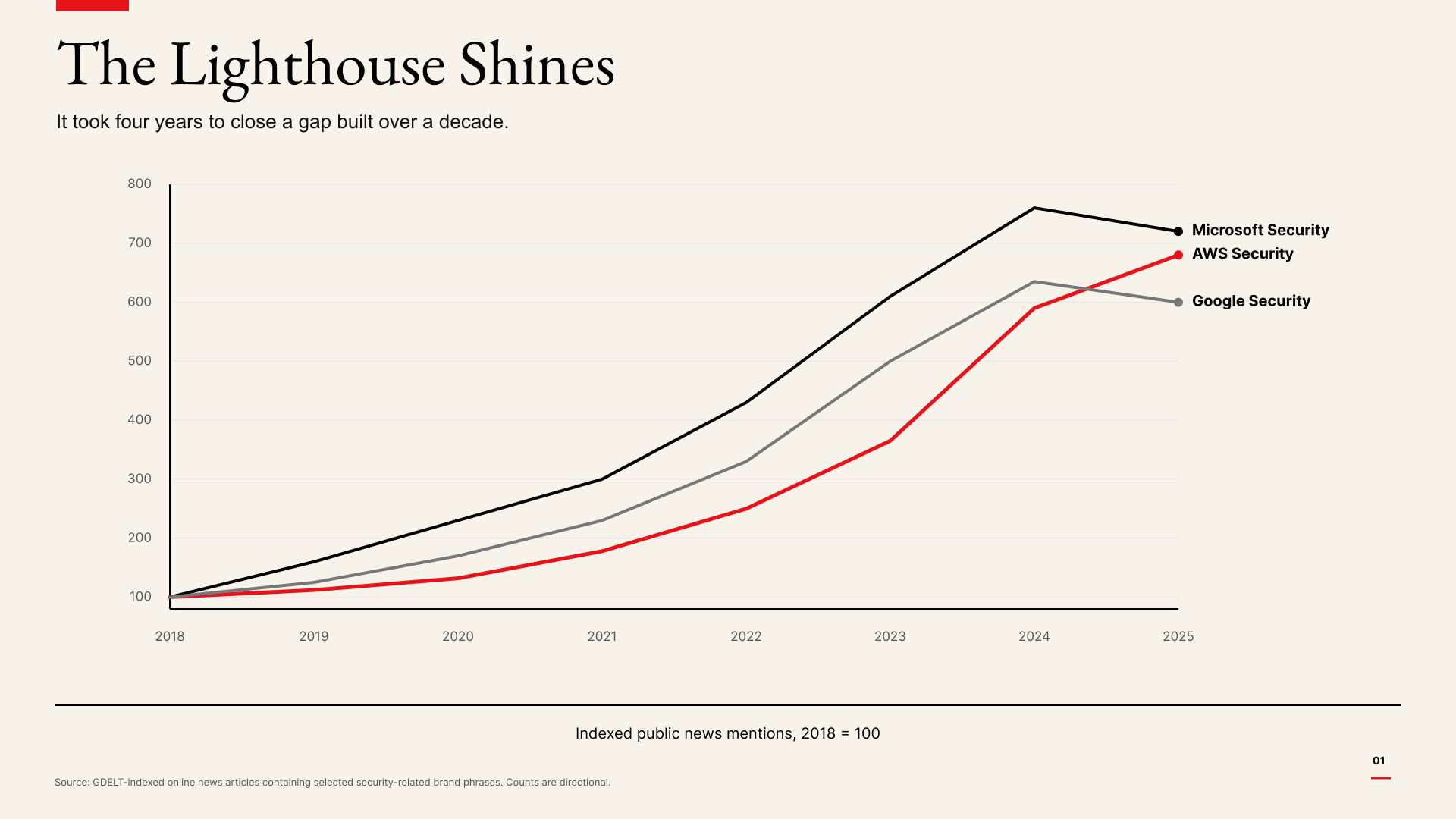
Security became a public conversation. AWS stayed out of it.
AWS had long carried public trust through its innovation and technical capabilities. It ran banks, hospitals, streaming platforms, and governments. Its competence was understood by inference. Security worked largely in the background. The general public rarely sees the cyberattacks that are prevented before they begin.
By the early 2020s, the market had changed. Security software had grown from an $8.7 billion global market in 2005 to a $123.8 billion global market. The media landscape evolved in parallel, as cybersecurity moved from specialist trade coverage and researcher blogs into mainstream business reporting on enterprise risk, regulation, trust, and executive accountability. Security was no longer a hidden feature; it was becoming one of the most important customer requirements.
AWS Security needed more than outside PR support. It needed a communications and storytelling operator embedded inside the security organization, someone close enough to the technical work to understand what mattered, skilled enough to translate it into credible narratives, and trusted enough by PR and legal teams to move those stories through the company. Hubert’s task was to build that bridge: create the relationships, language, materials, and operating rhythm that would raise AWS Security’s profile to a level befitting the market leader in a roughly $400 billion cloud infrastructure market, within a broader cloud industry worth hundreds of billions more. The goal was not simply to respond to coverage. It was to make AWS Security visible, quotable, and trusted at the scale its business already occupied.
How the Signal System Was Built
After speaking with internal stakeholders and the journalists shaping security coverage, Hubert built Lighthouse as a bespoke operating model for AWS Security. The objective was to make the organization’s technical authority more visible, more accessible, and more useful to the outside world. The model gave AWS Security a way to shine a clearer signal through a crowded security market by connecting senior technical expertise, journalist relationships, approved materials, and PR workflows into one repeatable system.
Lighthouse had four engines: Evergreen, Outbound, Queries, and Inbound. Each addressed a specific gap in how AWS Security reached the media. Evergreen created the credibility layer: executive bios, plain-language explainers, press kits, FAQs, and approved language that gave reporters a reliable foundation before a live story existed. Outbound built the relationship layer, putting AWS Security leaders on the radar of relevant journalists before there was an immediate request. Queries became the response layer, routing media questions by risk: routine asks could move quickly through pre-approved material, while topics involving incidents, vulnerabilities, or regulators moved through legal and security review. Inbound was the outcome state, the point where reporters began coming to AWS Security directly for context and interpretation. The model did not replace the PR organization. It supplied the security-specific map, materials, expert routing, and operating discipline that AWS needed, then connected them into the PR workflows already responsible for media handling.
Use the previous and next buttons, page numbers, or the keyboard arrow keys to move through the story. Press Escape to remove focus.
Results
- Top-tier presence in security and technology outlets rose 250% year over year between 2021 and 2024
- Inbound media engagement with AWS Security leaders grew 30x over the five-year program window
- Share of voice in security trade media climbed approximately 40% per year through the rollout
Why it matters
The Lighthouse model was built for AWS Security, but the problem it solved is not unique to security or to AWS. Any organization that holds deep technical expertise the outside world cannot easily find, understand, or trust faces the same gap. The instinct is to push harder on communications. The model showed a different answer: build a system that makes expertise legible before it is needed, and the signal compounds on its own.