OPINION
We Can Build AI Faster Than We Can Explain It
As machines learn to act, the bottleneck is no longer capability. It is comprehension.

In late 2025, AWS and SANS published a paper on securing artificial intelligence as it starts to act rather than merely answer. It was written by people who help run security at that scale, including one of the internet's founding engineers, and it is precise, current, and correct in every line. It names the exact moment the ground shifts: the point where a system stops handing back sentences and starts taking actions on your behalf. Thirty-one pages, not a wasted claim. The paper is rigorous, written for the people equipped to read it. The challenge is carrying that rigor beyond them, into the classrooms and conference rooms where a wider group has to understand what AI can do.
The standard answer is to shorten it. An executive summary, a one-pager, a deck of the deck. Every organization that has ever needed a wide audience to understand a deep subject reaches for this, and underneath the reflex is a quiet assumption that understanding is a volume problem: too many pages, not enough time, reduce the pages. A shorter technical document is still only a document; understanding requires more. The executive who reads the one-pager can now repeat the conclusions, which is a different thing from seeing them, and the gap between the two is where bad decisions live.
Consider how anyone actually comes to know a system. The knowledge arrives through use, not through description alone. You know a car because you have driven one, felt it respond, misjudged a corner once. If that is how understanding forms, then the honest way to explain a system is to build a working model of it and let people in.
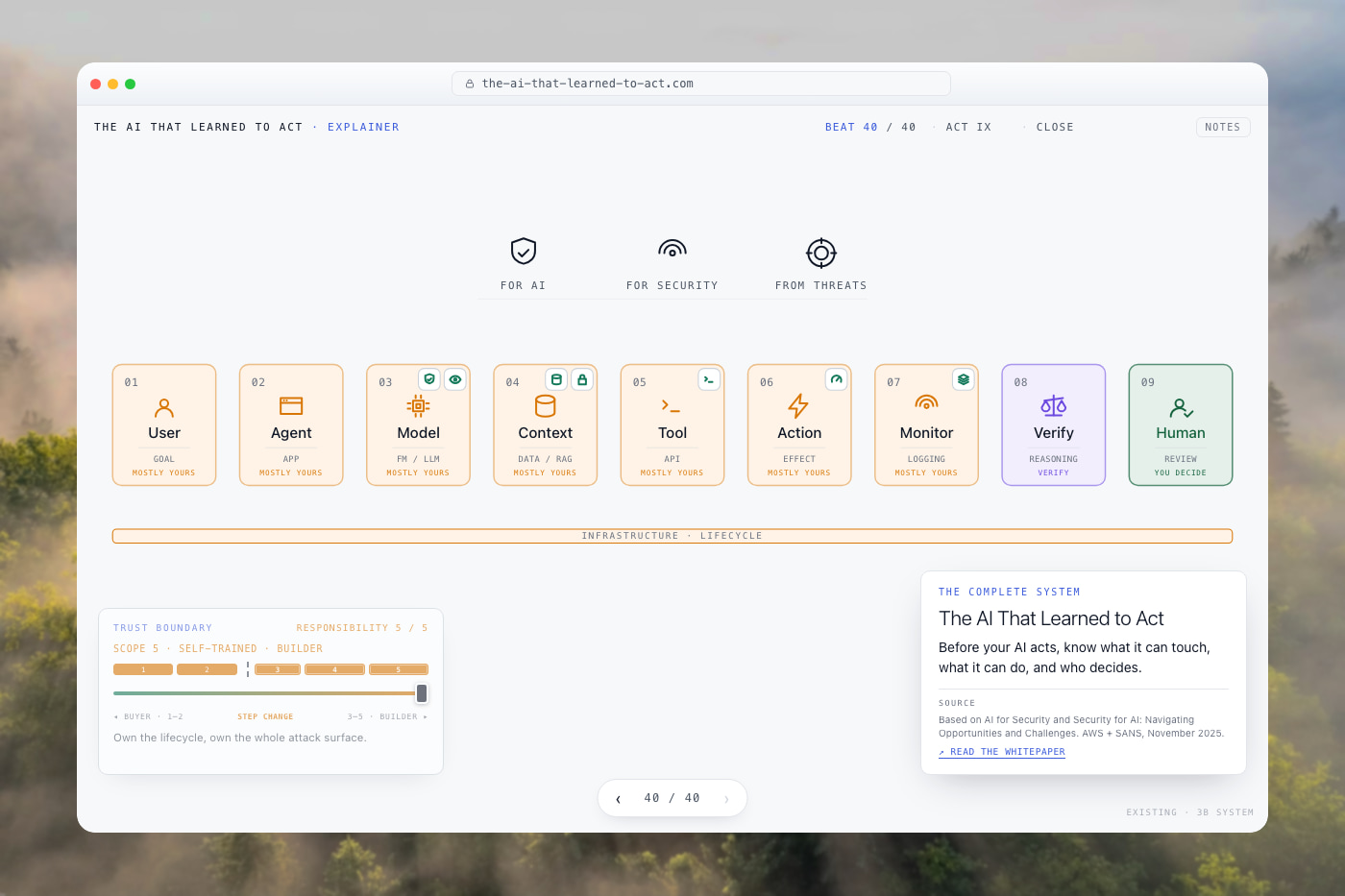
That was the brief when I was engaged, after the paper was finished. The discipline is strict: you are not allowed to know anything the source does not. Every claim traces to a page. I introduced no new facts. What I built was the paper as a place you could stand in, one continuous system that changes state as you move through it, instead of a stack of slides describing it from outside.
Interactive
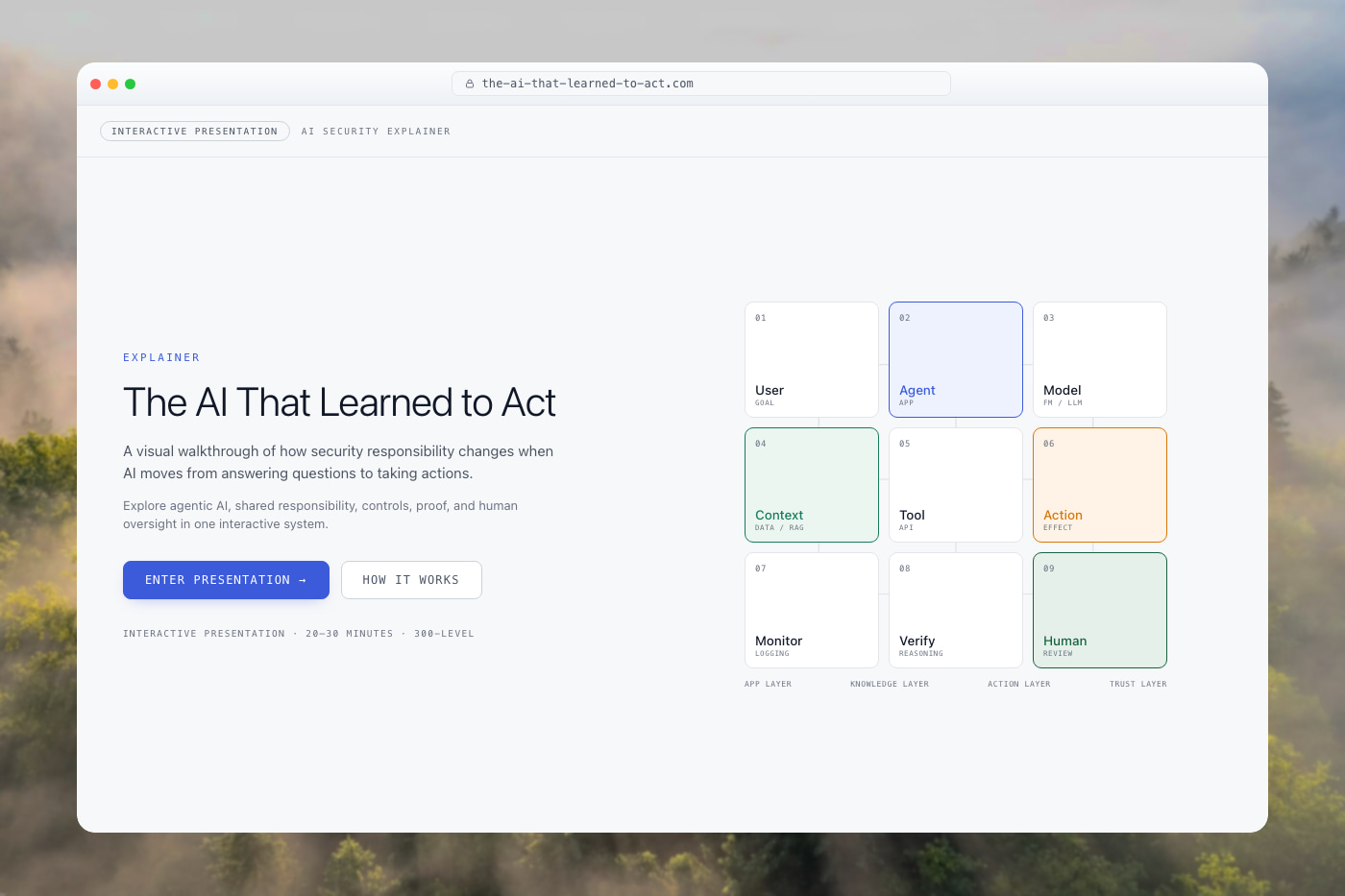
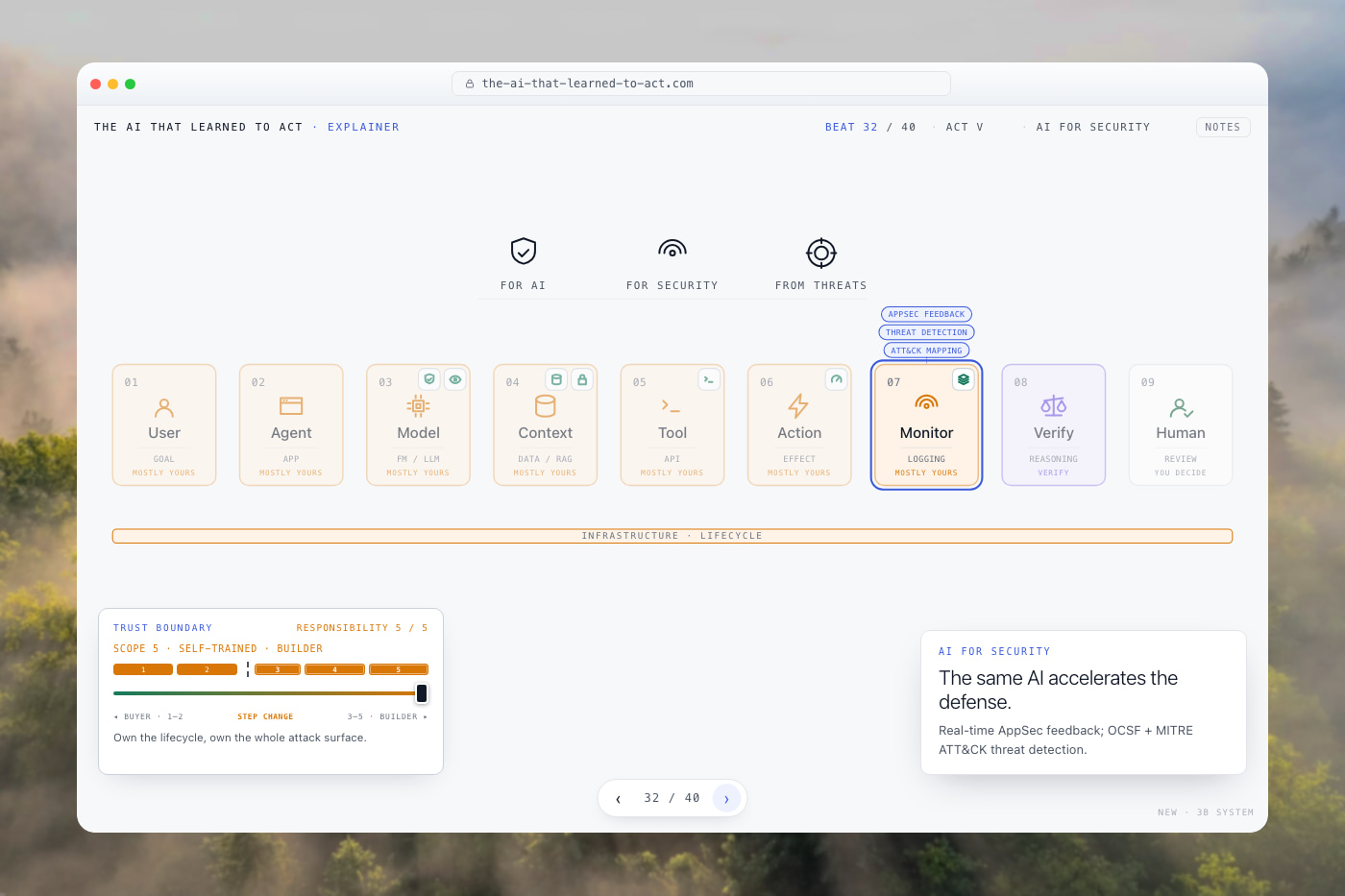
A visual walkthrough of how security responsibility changes when AI moves from answering questions to taking actions.
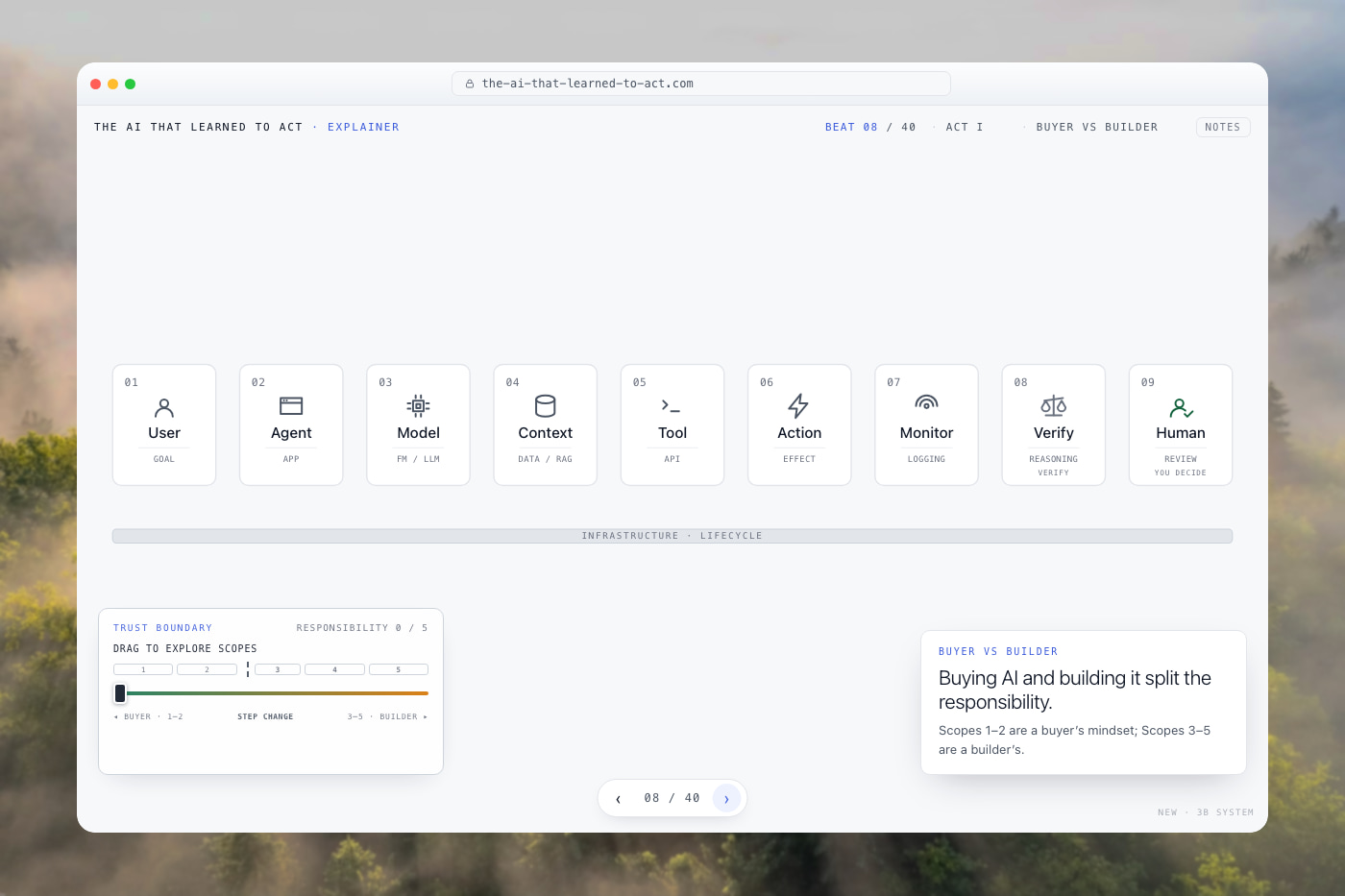
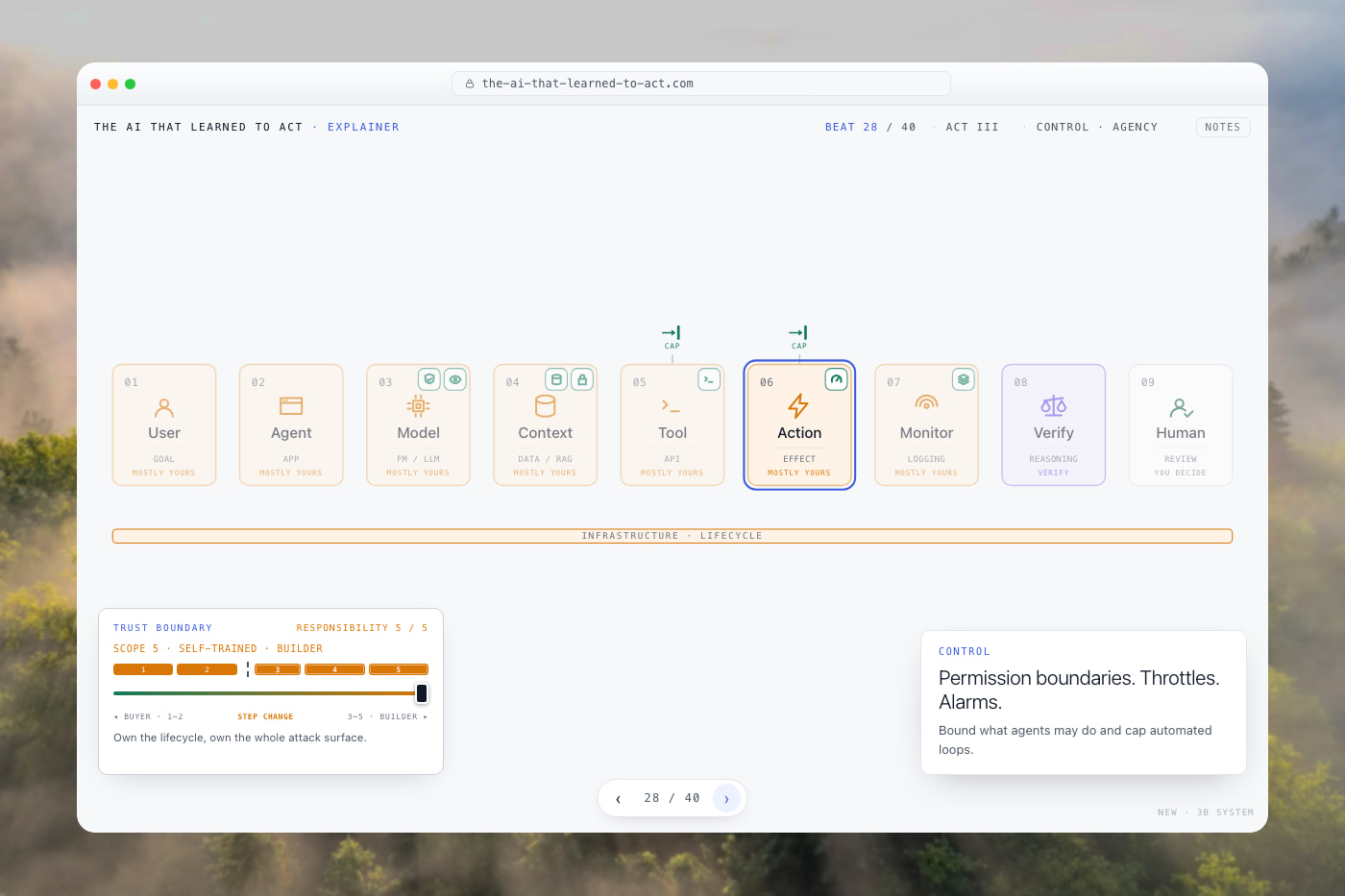
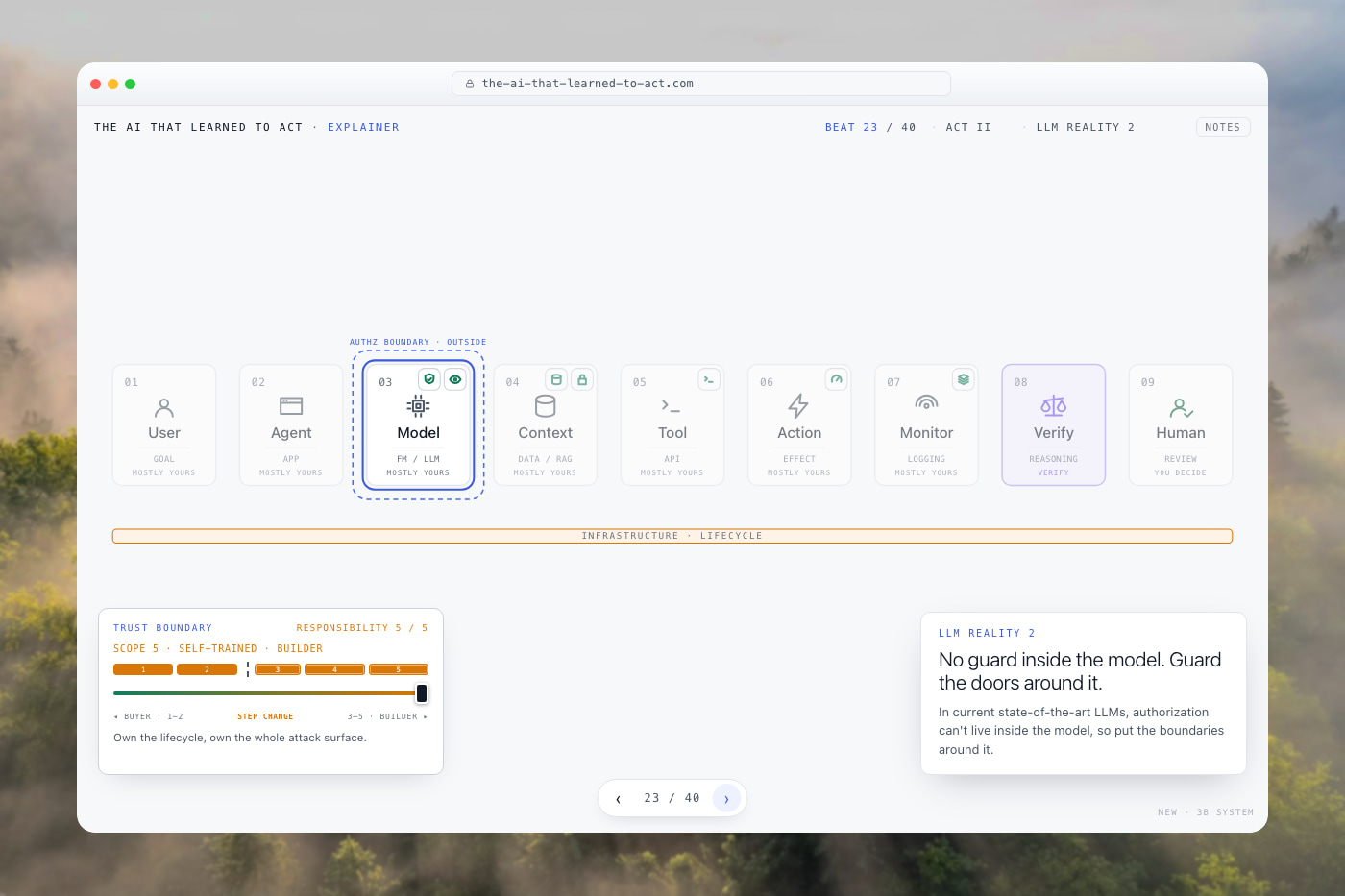
Enter the live walkthroughThe paper's real subject is responsibility. When an AI acts, who owns the action? On the page, that is an org-chart question. In the interactive experience, that distinction became a single line you could drag with your own hand: the border between the provider's territory and yours. Pull it one room deeper into your own operation and the meter climbs into amber, and three more controls light up as yours to run. Nobody had to be told where the responsibility sat. They found out by moving it, and a thing you have felt move is a thing you can still act on in a meeting six months later. A summary of the same material would have been read, agreed with, and gone by lunch.
The audience for this kind of understanding is suddenly enormous. When AI only answered, the people who had to grasp it were the people building it. Now the circle takes in everyone whose name is on the consequences: the executive who authorizes an agent to touch live systems, the counsel who signs off, the board that hears about it afterwards. The price of shallow understanding is rising too. A misunderstanding about AI used to produce a bad sentence. Now it produces a bad action, and the action has already run before anyone reads it. Nodding along has become expensive.
Expertise and compression are abundant. The harder craft is converting verified knowledge into an experience that leaves a working model in a thousand heads, at full rigor.
The people who wrote that paper did the hard part. They saw the shift early and set it down exactly. What remains is the growing, because AI that acts will be governed by the people who can picture it, and a picture cannot be handed over in summary form. It has to be built where the reader is standing. Right now we are producing the machines much faster than we are producing that.