COMMUNICATIONS · AGENTIC AI · OPERATIONS
Grants in the Darkness
Report: No One Could See How Large Academic Funding Had Become

Executive Summary
Amazon's academic engagement had scaled across the company with no central governance. The concern was company-wide, but Amazon Security became the pilot because its engagements carried concentrated reputational and compliance risk. The CEO wanted a full accounting and the organization could not provide one. Hubert Southall led the response, starting with a forensic audit that surfaced more than $50 million in untracked spend. His diagnosis: teams had not been evading governance. They had been operating in a system where funding ran on personal relationships, and no governed alternative existed that was easier to use. The fix required two interventions, a governance framework that made compliance simpler than workarounds, and a competitive intake model that made merit-based access simpler than calling a friend.
Use the previous and next buttons, page numbers, or the keyboard arrow keys to move through the story. Press Escape to remove focus.
The funding ran on networks, not process
The problem was not that Amazon engaged universities. It was how funding decisions got made. Money flowed through alumni networks, existing executive relationships, and informal referrals rather than any structured intake. Different parts of Amazon unknowingly invested in the same research, creating duplicate spend with no visibility. External institutions found Amazon impossible to navigate; without an insider contact, they could not pitch their work. The system selected for connections, not merit. No one could see the aggregate picture: how much had been committed, where the money went, or whether the right reviews had been applied.
Missing approvals were the symptom, not the problem
Hubert ran a three-month forensic audit of Amazon Security covering three years of activity, tracing engagements through planning documents, ticket histories, funding signals, and direct outreach to directors and senior leaders. He used Amazon Bedrock Knowledge Bases and Titan Embeddings to accelerate the search, because keyword matching could not find activity described a dozen different ways across teams. The same engagement might appear as a "grant" in a purchase order, a "research collaboration" on a wiki, and a "university sponsorship" in a planning doc. Embeddings searched on meaning rather than exact phrasing, surfacing related material and likely owners that literal queries missed. The audit surfaced more than $50 million in unmanaged spend. That figure reframed the problem from a handful of missing approvals to a major area of spending with no central visibility.
A policy memo would not change behavior the culture rewarded
The conventional fix, document the gaps, issue rules, require attestation, would fail because it still depended on employees choosing the governed path over the easier informal one. Hubert designed an Academic Engagement Review Framework with a single repeatable path: defined intake, engagement classification, risk-based routing, approval thresholds, and a monthly governance board. Engagements over $100,000 required VP approval. An Amazon Bedrock Agent handled intake: an employee described a proposed engagement in plain language, and the Agent classified the proposal, retrieved the governance requirements, and created the correctly routed ticket on their behalf. Before the Agent, an employee wanting to fund a fellowship had to find the policy, guess the right approver, and open a ticket that was often the wrong type. After, they described what they wanted to do and a correctly routed ticket appeared. Finding the process was no longer the employee's job.
The governed path had to work for both sides
Internal governance could control how Amazon reviewed proposals. It did not solve the other half of the problem. The relationship culture would persist as long as calling a friend remained the easiest way for external institutions to get heard. Hubert built a competitive intake model, an internal "Shark Tank" where researchers pitched proposals directly to Amazon leadership. The format inverted the old dynamic: instead of researchers needing a personal contact to be heard, they presented to a room of relevant Amazon scientists and leaders who evaluated proposals on merit.
Getting the right people in the room was the harder problem. VPs and Principal Scientists default to "no" on calendar requests. Hubert used Bedrock to analyze internal profiles and target only leaders relevant to each research theme, then removed logistical friction with custom travel packages their Executive Assistants could book in a single click. He secured speaking slots at organization all-hands meetings and placement in Amazon's internal newsletter to build attendance.
On the external side, he broadcast the call for proposals through research administration networks and university channels, and coached researchers on presenting to non-academic audiences. The pilot at Virginia Tech drew over 100 Amazon attendees and 10 presenters from Carnegie Mellon, Harvard, and UT Austin. Merit replaced networking as the entry point.

Results
- 100% of new proposals routed through proper review in the first year
- Zero policy violations post-rollout
- ~40% of reviewed engagements produced a direct hire, usable research, or IP
- Duplicate funding identified and reduced through centralized visibility
- Framework adopted as Amazon's company-wide model for academic engagements
- Foundation for a dedicated academic engagement governance organization
Why it matters
The pattern this work exposed is not specific to academia. Any organization where external engagement, vendor relationships, research partnerships, regulatory interactions, run through informal networks will eventually face the same gap: activity scales, controls do not, and the risk compounds invisibly. The instinct is to write stricter rules. But rules that are harder to follow than the workaround will be worked around. The framework Hubert built proved the alternative: design the governed path to be easier than the informal one, for both the people inside the organization making commitments and the people outside it trying to get heard. Amazon adopted it company-wide because it worked.
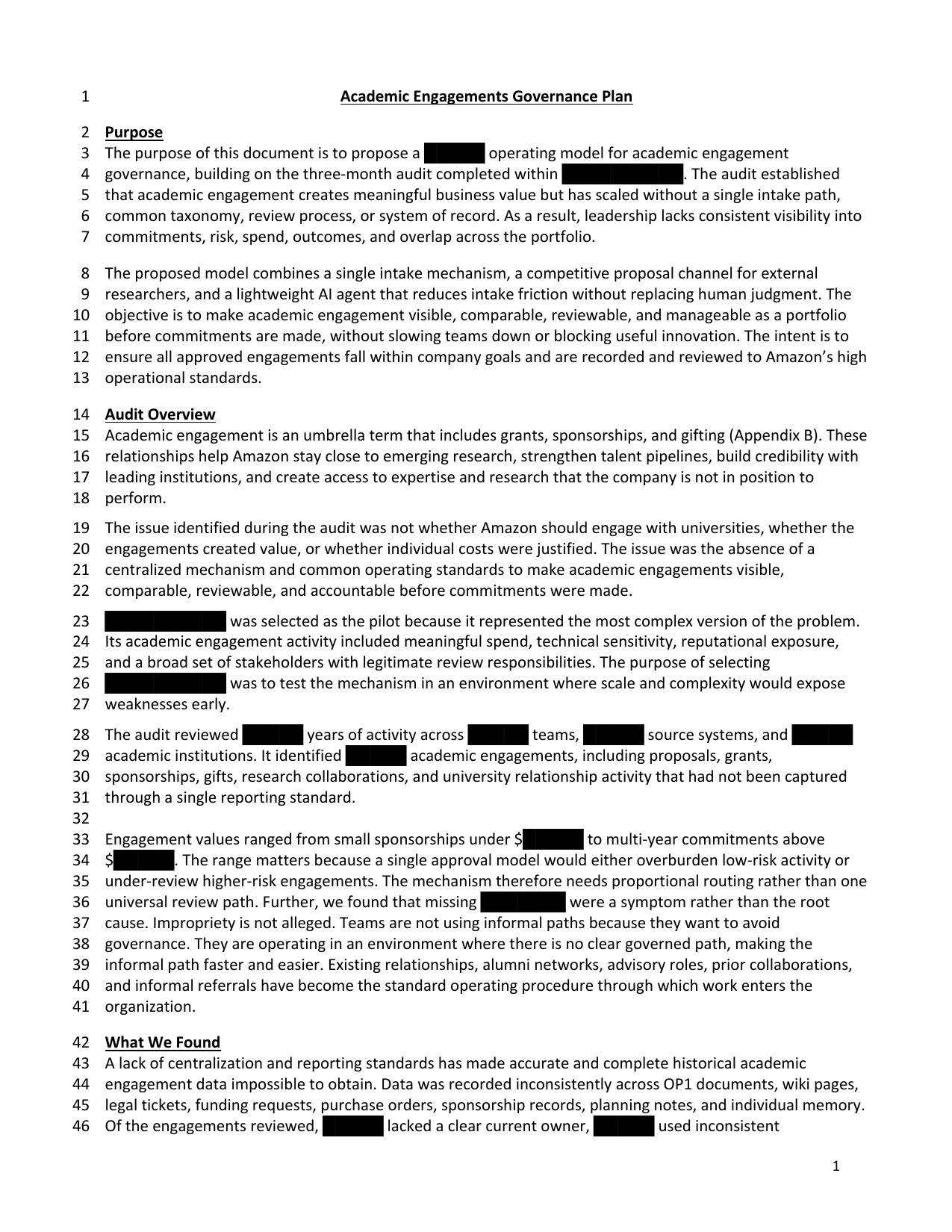
Document
A redacted governance report written to brief leaders on the audit findings, proposed intake model, and review process for academic engagements.